Showing posts with label Challenge 7. Show all posts

Wednesday, April 24, 2013

Image from tradition

from: Misik Kim


I have been teaching quilt at one university museum during several years.
So I can have a chance to see some old collections and nice exhibitions in that museum. 
I think it's a fortune for me and also gives me a relaxation in busy city life.


Every country has good old traditions and we can learn much from that traditions.
Recently some designs derived from old traditions are used in many products and have 
good effects.
So I selected subject of this work from old traditions, "image from tradition".
I wish it could be a good opportunity to see our old times.


Challenge 7: Image from tradition  
Orientation: Landscape (24" W x 18" H)
Gallery opens April 26, 2013


Friday, April 19, 2013

Northwest Coast Art Traditions


I really spent some time thinking about this one - Misik and Hsin-Chen especially have a real advantage here - they come from design traditions dating back thousands of years!  My country, Canada, is a babe in the woods - surely the youngest country in the group, having been a country for just 100 years (well, we celebrated our centennial when I was in high school, so if my math is correct, we are closing in on 150 years now!).  This doesn't leave much time to develop textile or design traditions.  We do have a Canadian tartan - the "maple leaf plaid" to the left, created just a few years before our centennial celebrations - but I couldn't see making an art quilt out of it (though I recall my mother loved it and made me a skirt out of it).


So I wracked my brain - would I have to go back in history and visit the ancestors in Scotland and Ireland to use their imagery?  But Canada is the homeland of some very creative indigenous peoples - the first nations tribes, the Inuit, and - from the Pacific northwest coast just off British Columbia - the Haida nation.  Luckily for me, the Canadian Museum of Civilization, just minutes from where I live in Ottawa, has beautiful Haida artwork by renowned artists like Bill Reid and Robert Davidson, and some ancient artifacts like this garment depicting an eagle and the carved ceremonial dish below. I also discovered a beautiful book Haida Art by George F MacDonald, where I learned the history of this fascinating people. 

For centuries the Haida have lived on the Queen Charlotte Islands, a remote archipelago off the northwest coast of North America (yes, there are even some in southeast Alaska). Art, myth and ceremony were an integral part of their lives, and over time they developed a rich, distinctive and powerful style of sculpture and painting. 

Haida art is distinctive in that there is little realism or naturalism in most of their drawings and carvings - creatures often depict large staring eyes, open mouths exposing rows of teeth and tongues, and faces can be seen in body parts like hands, eyes and torsos.  Most of the traditional designs I found are in black and red on white - beautiful, graphic images that are very appealing. Here is Dogfish Mother by Robert Davidson and Haida Beaver Tsing by Bill Reid:


So what can I do to put a contemporary spin on this traditional artform?  I think it will be fun to design a piece using the motifs, shapes and colours of Haida prints, depicting something very contemporary. The "big reveal" is just one week away, so be sure to visit again on April 26 to see what everyone came up with.

Friday, April 12, 2013

Everything Old is New Again

George Clapp's (my great-grandmother, Clara Ella Clapp's brother) ticket to
 the Philadelphia Centennial Exhibition, 1876
Who would have ever thought I would find a relevant use for this ticket.......but, this challenge has had me doing something I've wanted to do for some time.  That is, learn a bit about the history of the American patchwork tradition.  It's an amazing history that despite a bit of digging, I'm sure I've barely scratched the surface of.  Using internet sources, I tried to piece together cohesive little story, but I think it is more like the internet - clicking here and then on to another link and off on another tangent. For instance, there is a contemporary component to out patchwork quilting history...some of the patterns I read about were represented at Fashion Week in London this year....so I've included them!  Here's a little taste of what I found...old and new.  
Chez Marianne
Crazy Quilts
Old
So, first, we start with the ticket.....at the Philadelphia Centennial Exhibition, in 1876, and, in particular, the Japanese exhibit. At the exhibit, people were introduced to the Japanese aesthetic and a particular ceramic style, called crazing, with its fragmented appearance, that played a really important part in defining the Victorian fascination with Crazy Quilting.  Crazy quilting had been around for a while, as a utilitarian way to fashion bedcoverings out of scraps from garments by necessity.  But moving into the late 1870's, crazy quilting started to become more purposeful, with more design elements, employing scraps of silk and brocade and velvets, ornately embroidered, often with eastern motifs, such as cranes and fans.
Current/Elliott
New
The Moto Patchwork Jeans are a retro American style line of jeans created by Current/Elliott, available at Neiman Marcus for $348.  (I found it interesting that they included the model's measurements in the advertisement!) 

Tumbling Blocks

Holly Fulton

Material Pleasures, LLC


Old
Crazy quilts reached there peak in the late 1880's, but continued to be popular through the 1920's.  Meanwhile, pieced quilts started to gain popularity.  One of the earliest and most popular patterns was Tumbling Blocks, originally an opportunity for women to show off their fine silk scraps.  Tumbling blocks is one of the patterns that is part of the theory (now urban legend) of a code for the Underground Railroad, using specific quilt patterns to guide slaves to freedom in the north.  I always liked that idea, but historians have since written it off.
New
Holly Fulton, a Scottish designer, working in London, features a number of leather, geometric patchwork garments in her 2013 collections.


Grandmother's Flower Garden


One of a Kind Antiques
Storytailors


Old

Grandmother's Flower Garden has the distinction of being the first quilt pattern published in a "ladies book" in 1835.  The hexagonal pattern had been around in England since the 1700's, though the first American piece was dated 1807.  Earlier version were often called honeycombs or mosaics.   A fairly common pattern by the early 20th century, this quilt top is often found unfinished, because women just didn't know what to do with the edges to finish it.
New
The accompanying photo isn't from this year, but it was so spectacular, I had to include it.  It is from a 2003 collection, entitled, "Narkë, the History of a Dress", by Portuguese designers Luís Sanchez and João Branco, known as Storytailors.  The dress is one of many patchwork (and otherwise amazing) dresses included in the collections featured on their magical, storybook like website!


Gee's Bend and the Modern Quilt Movement


The Quilts of Gee's Bend
Paul Smith
Old 
The most recent addition to the quilting tradition (that I can think of) is the "modern" quilt movement that is rapidly gaining momentum.  At Houston last Fall, some of my favorite quilts were included in the "Modern Quilt Guild" exhibit.  Quilts of this genre share certain attributes, including, asymmetry, negative space, more solid colors, and unconventional block structure.  Correlations are frequently drawn with Gee's Bend style of quilting.  From the Modern Quilt Guild blog:  "Modern quilting is just about quilting in a way that reflects you, the modern quilter.  It is a style of quilting that reflects your life, your aesthetic, and sometimes your general approach to the world.  Mary Lee Bendolph, one of the famed Gee's Bend quilters says it best, "I never try to quilt altogether like anybody...It's better if you do what you are supposed to do than to try and copy somebody else."
New
English fashion designer, Paul Smith, has a number of dresses in his 2013 collections that I thought reflected the attributes of modern quilts and by default some of the Gee's Bend quilts.

This challenge has made me acutely aware of how little I know about the American quilting tradition - something I'd like to continue to work on.  There are so many interesting stories about every pattern out there.  Each of the captions on the photos above will link you to more information about or more photos of the images shown.  Any of these patterns alone could fill an afternoon of surfing and reading.  It's hard to distill so much information!  At this point, I'm fairly uncertain where this challenge will take me, but it has been an interesting journey thus far and I'm really eager to see where others have gone with it!

Friday, April 5, 2013

Something Borrowed, Something Blue

The first thing that leapt to my mind when reading about Misik's challenge to bring new life to old tradition was Celtic imagery.  Mom's a McGill, jokingly called a lace curtain Irish by my dad for many years.  Well, it looks like Kate was ahead of me, and will do her usual superb interpretation of that idea.
My grandmother, on the other hand, was the daughter of a Norwegian sea captain.
The simple geometry of nordic design is extremely appealing, however, I've borrowed from in for many years already, particularly in my knitting-
 
So, instead, I'm *again* returning to tradition from the country of my birth, Japan.
Both my parents were entranced by the history and culture of Japan- here's my mom, pregnant with me, and one of her attempts at ikebana-
This is literally the first view of the outside world that I had in my life, the world through our living room window-
A quilt from this idea already exists, it's called Momoko, after my birth name.  Such a fat, pink fuzzy baby had never before been seen, and mom put me in the window for all the curious neighbors to see, who began calling me little peach - momoko in Japanese.
The piece is of Kanaka-san, my mother's helper, sitting contemplatively by their window.
I used raw silk that mom had acquired there as the "wallpaper", stenciled with peaches, and an actual overdyed cotton hakata for her robe.
I think I'll borrow another Japanese tradition for this challenge- it's spring, with all the tumultuous weather typical of the high desert- it brings to mind haiku.
The tiny green buds of  the trees are especially inspiring against the stormy gray sky- perhaps I can start there.  What do you think?


Thursday, March 28, 2013

The Vanishing Culture

by Lin Hsin-Chen
Life is a combination of numerous coincidences. When I completed the 6 challenge, I shared the idea of making a quilt with my collection of old traditional fabrics with my friends. Then, I received our 7 challenge, “Image from Tradition”. What a great coincidence! Thank you Misik for giving me this incredible opportunity!
I attended an opening ceremony of a cultural exhibition at a museum in Taiwan on March, 24th. The theme was “The Vanishing Culture of Taiwanese Aborigines - The Pingpu Tribe”. The exhibition introduces the people who lived in Taiwan Island around 4 to 5 thousand years ago. The people are what we called “The Pingpu Tribe” today. Their traditional culture and customs are replaced by the Han Chinese culture gradually in the recent 4 hundred years. Many of the valuable antiques are also taken away from Taiwan by the new residents. Many of the exhibits displayed in the exhibition are from overseas. It’s nice to see them “coming back” to Taiwan again. I am especially attracted by the fiber and costumes of Pingpu people, so I decide to do some research about them.
The Pingpu people use natural plant fibers, such as cotton and linen, to make their clothes. They use waist looms to weave. Plaid is the most common pattern they use, and natural dyeing colors such as red, yellow, green, purplish blue, orange…etc are common to see. The most gorgeous costumes of Pingpu people are usually decorated with delicate brocade. The handmade techniques present the simple and pure lifestyle at that time.


I was born and grown up in Taiwan, but it’s my first time seeing the primitive culture. I’m so touched and feel very lucky to experience the vanishing culture. All the photos posted here are not the antiques of thousand years ago (but 400 years ago), because I can’t take photos of the oldest antiques. They are too old to be attacked by flashlights anymore.

To be honest with you, the exhibition changes my original design plan for the 7th challenge. My plan of challenge 7 now remains unknown.


Friday, March 22, 2013

Delectable Mountains

Hueco Tanks pictograph
The earliest peoples present at Hueco Tanks TX, 10-11,000 years ago, were the peoples we refer to as Paleo-Indians and belonged to the Ice Age peoples that spread across North and South America at least 12,000years ago and possibly as long as 40,000 years ago.  Think mastodons, giant bison and other big grazers.


Hueco Tanks pictograph
Then 8,000 years ago, after the large animals had disappeared, the human population depended more on small game, such as sheep, deer, antelope and rodents...in addition to collection and processing grains, nuts, fruits and tubers.  The artwork painted on the cave walls depict what appears to be hunting scenes.


Pictograph: relative size


Lightning pictograph
Arriving about 2000 years ago where peoples who had domesticated corn, beans, chili peppers, squash, and wild grasses.

 The people are known to anthropologists as the Jornada Branch of the Mogollon who arrived sometime around 450AD.  Their paintings have a strong religious influence...that continued through the centuries in the Pueblo peoples of today.

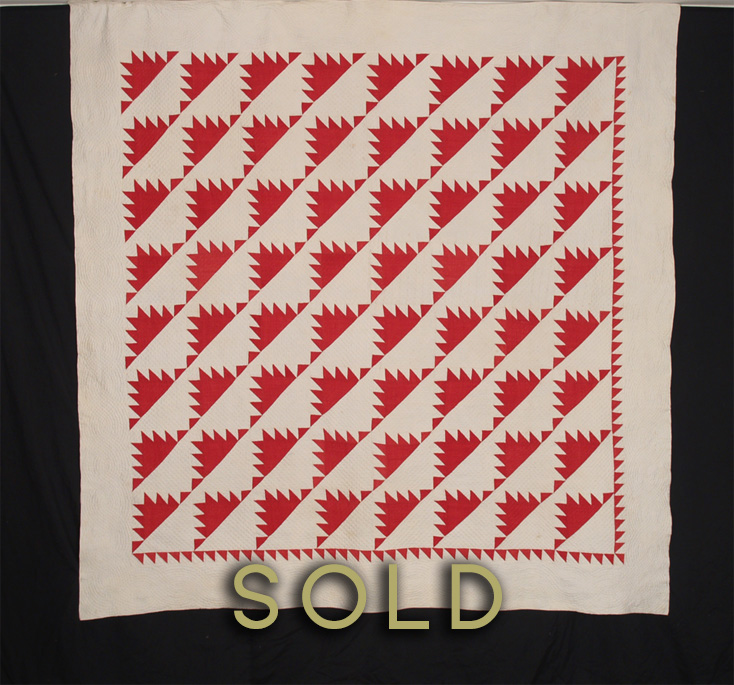
This abstract painting has a strong resemblance to the Delectable Mountain quilt pattern...and to some of the cave paintings in Australia.  The Hueco Tanks' guide actually refers to these as quilt patterns.  What is not easily seen is that there is an abstracted face with huge eyes.  All symbols of rain and lightening.

I was thrilled with the day.  Hueco Tanks has one of the largest concentrations of Indian rock paintings in North  America.  Impressive arrays of prehistoric and historic Indians...designs that continue in today's Indian cultures.
Delectable Mountains: 1800's quilt

Friday, March 15, 2013

Éirinn go Brách

If you hear people saying this phrase on March 17 (or the English-friendly version “Erin go Bragh”), it means “Ireland Forever”.  With St. Patrick’s Day coming up this weekend, I’m inspired to celebrate my Irish heritage.  My father, Joseph Patrick O’Brien, was born in New York but his ancestors trace back to Tipperary and other parts of County Cork, Ireland.  Our family has always been proud of our Celtic heritage; the O’Brien coat of arms hung in a place of honor in my parents’ house.  

Kells_PI remember we had a coffee table book about The Book of Kells, full of breathtaking color photos. The Book of Kells is an illuminated manuscript containing the 4 gospels of the New Testament, written in Latin by Celtic monks around 800 AD.

But even if I could read Latin, I wasn’t interested in the words.  I would study the images for hours, entranced by their almost magical beauty.

Ireland is now a mostly Catholic country, but it’s history with Christianity and Catholicism has been complicated and often turbulent. Many of the druid and pagan traditions were “co-opted” by Christians as a way of erasing or at least transforming Celtic culture.  Alban Arthuan became Christmas, Samhain became Halloween. 

Who knows how long the Irish people continued to keep their pagan traditions after Christianity swept through with St. Patrick.  But I liked to imagine the illustrator of the Book of Kells was actually sending secret Druid messages, hidden in these mind-bogglingly elaborate designs. Some of the chapter pages reminded me of blueprints or architectural drawings. Could this be a treasure map? A description of some sacred grove or meeting place?  I mean, why would someone spend a year illustrating the letter “P”?  It defied logic. This had to be more than just colorful decoration, I was sure of it! 

Kells is full of well known symbols of the ancient Celts: spirals, knots, stylized animals. Some drawings contain up to ten different colors of ink and ornamentation to such extremes it makes the biblical text secondary, if not irrelevant.  In some cases the letters and words are almost lost inside mazes of interwoven lines.  It’s obvious that the monks who illustrated the book were familiar with Celtic stories and symbolism.  Some historians say the Book of Kells contains examples of ALL the known designs found in Celtic art.

kells_chi_rho_bowl

Some say these colorful pictures were used to explain a story to people who couldn’t read.  But even at the time it was written, this book would have been extremely expensive to produce.  It would have been a precious object, kept at the high alter of a church, not passed around for townsfolk to flip through.  So, for whose benefit were all these painstaking hours of drawing done?  What story were they really telling?  Was this a way to explain the life of Jesus using the familiar allegories and symbolism of the local people?  Maybe. 

Or… maybe the bible was just a vehicle for the artwork, wrapped in religious reverence to ensure the book’s survival.  I like to think it was a clever way to preserve the art and culture of the ancient Celts forever.

Friday, March 8, 2013

Australian Wagga quilts

This intriguing challenge set by Misik Kim to use traditional images made me think of the Australian patchwork legacy. A new country, settled by Europeans a little more than 200 years ago, we have some remaining items that point to the skill and refinement of the craft. The book by Annette Gero, The Fabric of Society, Australia's Quilt Heritage from Convict Times to 1960, is a great resource of beautiful examples.
And we even see a patchwork spread on the bed in this Ned Kelly series painting by Sidney Nolan.
Aboriginal people used possum skin to make cloaks and blankets, patching the skins together to make the necessary size. Waggas are another utilitarian invention using woollen suiting samples, old coats and cotton fabrics to ' make do' and often  recycling used clothing as the inner layer for warmth. Used by farmers and those working outdoors in rough conditions they were made to stand up to the harshness of daily life in the 1930's Depression and beyond.

Where this is all taking me I'm not so sure at this stage, but it is giving me food for thought.