Showing posts with label Challenge 3. Show all posts

Thursday, August 23, 2012

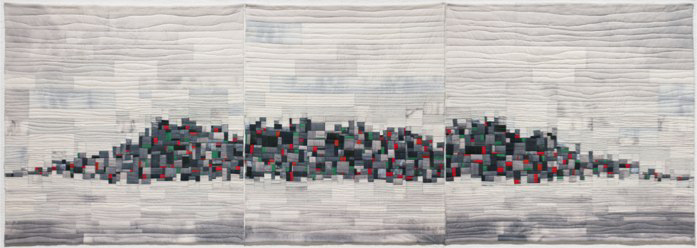
Challenge 3: Horizon

Artist: Lin Hsin-Chen


To overcome successive challenges is an integral part of learning in life. After the second challenge, I can create a more solid conceptual foundation for later development.

 “Horizon” refers not to a real line but to the infiniteness of the line which can only be perceived by feelings. Therefore, we should not search for line, but rather find a way to perceive the line. Lines are indeed a medium that can spark human beings’ creative genius, as well as their impulse for communications, by which the texture of knowledge is born.  

Nature is separated into upper and lower sections by the horizon, generating spatial vocabulary and dialogues. Humans unknowingly come to accept the linear attributes captured in time and space, and meanwhile some sense of awakening, some sort of subtlety, also arises in their hearts. Yet, where on earth do these feelings come from?

Delicate lines carry emotions and expressions, and also other aspects than that should be explored. I want to challenge all kinds of perspectives about lines and discover the touching consonances and fascinating textures composed by lines.   

Sunday, August 19, 2012

Finding Lines

Previous challenges inspired a lot of thought; my mind raced with ideas and possibilities.  But it was difficult for me to interpret those ideas into a concrete design.  This time, I was more in my “comfort zone”.  Horizons, lines, boundaries – these concepts are much easier to imagine visually.

IMG_5283
I began by exploring lines that are “real” in that they exist independently of ourselves – blades of grass, the line formed by two planes intersecting (like 2 walls meeting in a corner), stripes on a tiger, the mast of a sailing ship.

Other lines are visibly obvious - we can see them, draw them, photograph them and name them… but they do not represent an actual concrete object. They appear under specific conditions and are influenced by the relationship of objects.  They are constantly moving or changing. The horizon changes according to our location and the objects in our field of view.  Shadows change according to the time of day and weather conditions.

I thought about other lines that are neither visible nor “real” in the concrete sense, but have a great affect on people’s lives, like time zones or boundaries between countries.

Happily, I was able to get started on my design pretty early in this challenge.  As I considered these different ideas, pictures were forming in my mind.  I mentioned my “comfort zone” – how I usually put together a composition. I try to create a believable sense of depth by playing with light and shadow, and I love to explore the effects of light bounced off different surfaces.

This challenge allowed me to play around in my favorite “sandbox”.  I’m excited to share my results and to see all the challenge designs next week!


Sunday, August 12, 2012

Changed perspective

Next week I will be jetting off to Taiwan for the Taiwan International Quilt Exhibition 2012 and will see many great quilts that will change my perspective of art quilting in Asia. So to, this Horizon Challenge set my Hsin-Chen of Taiwan has made me look at my perspective of horizon. I began work with these cotton, printer ready sheets. My challenge to myself was to see how I would use this technology to portray my quilt vision.
A bit of this followed, sorry can't give it away here!
This commercial fabric, bought at the quilt store in Durango, Colorado  made it onto the back of the quilt, as it was appropriate for the image I'd chosen to work with.
A bit more rotary cutting and I was ready to bind my quilt. All will be revealed on August 26, so please stop by then.

Sunday, August 5, 2012

The Landscape

by Misik Kim

I saw the image of Lin's challenge, that comes to mind first was gray color.
I felt comfortable, like the landscape of the countryside of my country.
I prefer to express with colors than realistic expression.
To read various artist's different approaches is a very interesting thing.
This is also a challenge to me.
How to approach and how to interpret.....
all these things are interesting for me.

I remember this work “ Christmas in the town” and other works.

The detail for “The Temple”
The detail of “In the Mt Bookhan” 
I remembered my works associated with landscape.

Then I try to express different direction.

It is my challenge.

I will go to Taiwan to participate in the Exhibition TIAE 2012 in the middle of this month.
I’m looking forward to seeing Sue Dennis, Mary Pal, and Patricia Gould in there.

Sunday, July 29, 2012

Waiting is the hardest part


Climbing "The Ampitheater"


 I’m a planner by nature, so when I see a new challenge, I instinctively begin scheduling the steps between initiation and completion. This worked well in my business career but is mostly irrelevant in the world of art. Having said that, by this time – midway through the challenge timeframe – I typically have an idea of my direction and often several design alternatives.

No such luck this time!

I admit to being stumped. Not enough ideas? Too many? Usually when I struggle, I try to shake up my routine and do something outside my normal bounds. This time, it happened serendipitously.
 
I was out in Colorado when a friend offered to take me mountain climbing. Having never been, and having a slight fear of heights, I hesitated. But I trusted my friend implicitly and knew he was a very experienced climber. How many times do you get an offer like that? So I said yes.


I made it!


And lo and behold, climbing opened my eyes to the strength, subtlety and omnipresence of lines.  During my climb I encountered these:

 1. Safety line
 2. Line of sight
 3. Line of ascent
 4. Line of rock (crack, fissure)


Each served a different purpose: boundary, perspective, path, tool. Each had different characteristics: stable, changing, planned, historical. I marveled at the variety of meaning and interpretation.

I still don’t know exactly where this will lead me in my next quilt, but I did learn an important lesson: when I struggle to conceive, I get nowhere. When I relax and notice what’s around me, inspiration abounds. 

It’s the waiting, that’s the hardest part.

Sunday, July 22, 2012

Excitement on the Horizon

Just when I begin to think I have a handle on how to approach the assignment of making artwork that responds to the task set by the Challenge Master, the next puzzle appears and I face the same conundrum: how to interpret it.  The weekly responses are really helpful because they are totally different from one another and often very different from what I have been thinking about.  


Betty focused on horizons, Martha on lines.


At first, when I read Hsin-Chen's challenge, my mind leapt immediately to its usual default: literal and representational.  I researched "horizon" and found the expected references to horizon in Astronomy, Geology, Archaeology, and of course, the intersection of earth and sky.  

This line of thinking brought to mind some small landscapes I have made to teach students how to portray sky and earth on fabric using paintstiks.  


They certainly satisfy the definition of where the earth meets the sky, and perhaps it is the perspective provided by the horizon line in landscape art that is so compelling to viewers: what is just beyond that far hill? The depth beckons to us and invites us to step into the picture.


But I read on and one definition of 'horizon' intrigued me:  "the range of one's knowledge, experience, or interest; the scope of a person's education, understanding, etc.: His horizons were narrow."  And I was delighted to read a little further: "Synonyms: world, perspective, domain, viewpoint."  How fitting for our group!  


I mulled this over, and in subsequent discussions with wonderful artist friends of mine (a shout-out to Nysha, Linda B, and Pat C), I realized that the reference  'delicate lines carry emotions and expressions' permitted me to interpret them as the lines that appear on a face over time ... and that life presents us all with horizons all the time; some approach them boldly and with confidence and some regard those horizons as limits. So it would not be unreasonable of me to select a portrait to depict my response.


Or, in the interest of "expanding my horizons," I have given some thought to this confirmed machine individual using hand-stitched 'lines' of thread to sketch an image.  I have some sashiko threads and gorgeous heavy cotton I brought back from Tokyo and this would be a perfect excuse to use them.


And that sums up the reason being in this group is so great for me: with each successive challenge, I can use whatever interpretation I want to in response, and am not restricted to particular materials or techniques. This kind of openness is both daunting and emancipating.  


I leave for Taiwan in three weeks to teach at the Taiwan International Quilt Exhibition - so I don't have time to dally! Looking forward to hearing what others are thinking about as they face this challenge.

Sunday, July 15, 2012

What's my line? (or Things I Will Miss About Florida)


line/līn/, noun, the movement track of a dot

(Odyssey of the Mind, 2010)

First, I have to say, this challenge, to look at all perspectives and discover what is composed of lines, is fascinating.  It's been on my mind every day since Hsin-Chen proposed it!  Line is something taken for granted, never really contemplated, but ubiquitous to our lives.  So, my first step was to research the significance of line....

Space Shuttle launch, 2009
There's and interesting article "An Analysis on the Influence of Line in Chinese and Western Painting on Visual Shaping Language" by Jianqiu Sun and Chang Xiao, who observe, " The line of western painting, a rational painting element possessing the meaning of interpretation, is in pursuit of shaping and creating exact outer body shapes; the line of Chinese painting, besides delineating body shapes, stresses the spatial organization relationship of lines. The line of Chinese painting contains independent aesthetic value, “lines are for shaping” and conveys philosophy concept of eastern culture “the union of heaven and humans”.


Rocket launch, 2011


Continuing from the definition above, they note "the movement track of a dot, is a movement track that can be visualized, and can represent the spirit of the person or object that initiates that line".  Now that I am thinking about it, of course.  The lines we make with a paint brush, or the line of poetry we write, or even the lines of our home where we express ourselves, these are all lines that represent our spirit.  The spirit can also be expressed in a our signature, I am thinking, perhaps because I have signed so many papers lately.  Graphologists say they can read a person from their handwriting.  Interesting.


Shuttle contrail signature


Rocket contrail signature


Because of where I've been living, I have had the good fortune to watch some amazing things over the last 7 years.  Every Space Shuttle and rocket launch has been a glorious and daunting sight!  Several things I particularly enjoyed, beyond the amazing "movement track of the dot" were the magnificent rumble you could feel several minutes after the launch when the sound had traveled to us.  The other thing, was the signature left behind by the contrail as it started to dissipate.  The spirit of the Space Shuttle?


Nesting Loggerhead Sea Turtle signature
photo © Ann Zscheile 


Newly-hatched Loggerhead signature
photo © Ann Zscheile


Another awesome thing has been the opportunity to witness the life cycle of sea turtles, as this is the nesting destination of three species of these amazing creatures.  If you don't have the good fortune to encounter one (or many) of them, they often have left their "signature" on the beach overnight, very distinct lines created by these massive creatures hauling out to nest or delicate, lacy lines made by the newborns making their way to sea.  The spirit of the sea turtle?


It's challenging to me to decide which direction to go with our line challenge.  I have so many distinctly different ideas about the subject and any one of them creates so many new questions when I start to ponder their meaning.  A very profound, thought provoking challenge. I look forward to everyone's interpretation!


Sunday, July 8, 2012

My friend Gale pointed out that you can always look at the horizon, but you can never get there.  That thought really ties into the way I feel about my work- every piece is a new journey, full of promise and *sometimes* fulfillment, but it ends up as a gateway to something else.


I love this quote by Kandinsky:


"An empty canvas, apparently really empty, that says nothing and is without significance. Almost dull, in fact. In reality, however, [it's] crammed with thousands of undertone tensions and [is] full of expectancy. Slightly apprehensive lest it should be outraged ... It can contain anything but cannot sustain everything ... An empty canvas is a living wonder -- far lovelier than certain pictures."


To me, every project is a journey,which leads not to a destination, but to further horizons - the act of creating itself is as integral to me as breathing.


It's great that the next SAQA conference has Expanding Horizons as the theme.  We meet, share thoughts and ideas, and come away with a wider word view and a new appreciation of things that are possible.


Finally, I'd like to close with a quote by the Uruguayan writer Eduardo Hughes Galeano-


“Utopia lies at the horizon.
When I draw nearer by two steps,
it retreats two steps.
If I proceed ten steps forward, it
swiftly slips ten steps ahead.
No matter how far I go, I can never reach it.
What, then, is the purpose of utopia?
It is to cause us to advance.”
― Eduardo Hughes Galeano


********what's out there for all of us?  Am looking forward to the results of this exquisite challenge !***********